|
|
Thunderball |
|
|
||
|
|
Thunderball |
|
|
||
 |
|
|||||
|
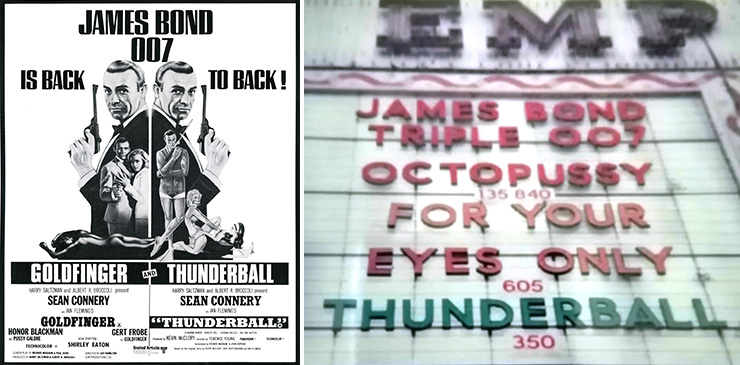
Thunderball was re-released in cinemas on a double-bill with Goldfinger in the UK in 1968, then with Dr. No in 1972, and again with You Only Live Twice in 1974. When Producer Kevin McClory exercised his rights after the original ten year embargo had expired, he finally coaxed Sean Connery back to the role of James Bond in the film that was ultimately released as Never Say Never Again in 1983. A week before the UK premiere EON Productions and then distributor United International Pictures reissued Thunderball (1965) on a triple-bill with For Your Eyes Only (1981) and Octopussy (1983), which played exclusively at the 1,330-seat Empire 1 cinema, Leicester Square, which then had a huge screen (60 feet wide by 25 feet high). The print of Thunderball was struck from the original negative in 1979 and was a clear signal to the makers of the rival film that although Roger Moore was the ‘official’ James Bond at the time, it was Sean Connery in the same series that made the Never Say Never Again story first! Thunderball was then shown on the ITV network on January 2, 1984, garnering an audience of 16.65-million viewers and the most-viewed programme that week – an amazing achievement for its third television outing. Thunderball had also been successfully re-issued in the USA with From Russia With Love in 1968, and You Only Live Twice in 1970-71 ahead of Sean Connery’s return to the role of 007 in the EON Productions series. |
|||||
|
|||||
|
Sixty years on, Thunderball remains the most financially successful Bond film of the EON Productions franchise when adjusted for inflation, though fans remain divided over its slower underwater sequences and technical flaws. At the time, however, it was cutting edge cinema. Despite becoming disillusioned with the role of James Bond, Sean Connery gives what is arguably his most assured performance in the series, ably supported by a talented international cast – and behind the scenes, the quality of continuity followed through with most crew members working on their third or fourth consecutive James Bond film. The move to the widescreen Panavision format and Ted Moore’s lush cinematography gave the film a grandeur absent from earlier entries and does full justice to the exotic locations chosen for Thunderball. Kevin McClory’s initial story outline and Bahamian connections were integral to the film’s success, despite varied legal disputes. Although the Irish filmmaker would later become a bigger thorn in the side of EON Productions, he was an important part of the evolution of the story, and instrumental in getting the film made at all. Albert R. Broccoli was later godfather to Kevin McClory’s youngest daughter and the two filmmakers were still clearly on good terms during the THUNDERBALL embargo period as McClory and his wife were invited to the World Premiere of On Her Majesty’s Secret Service in 1969. However, as soon as he was able to exercise his screen rights in the THUNDERBALL property, Kevin McClory embarked on many futile attempts to bring James Bond to the screen again. This resulted in several lawsuits in the ensuing years as both camps clung desperately to what rights they had and could prove in court. Not until after Kevin McClory’s death did DANJAQ/MGM acquire all the rights and interests relating to James Bond from his estate, thus bringing an amicable conclusion to the legal and business disputes that had arisen periodically for over five decades. |
|||||
 |
|||||
|
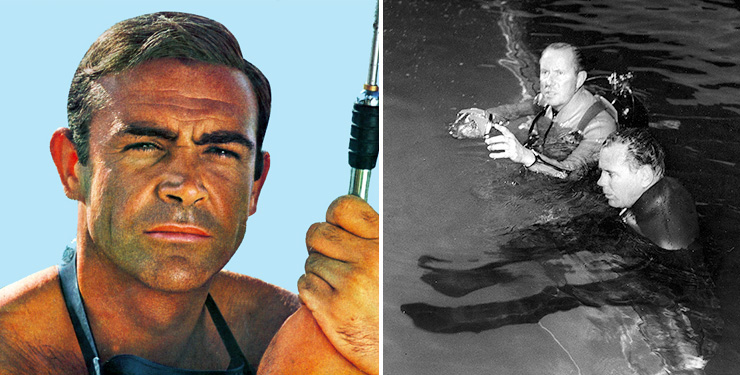
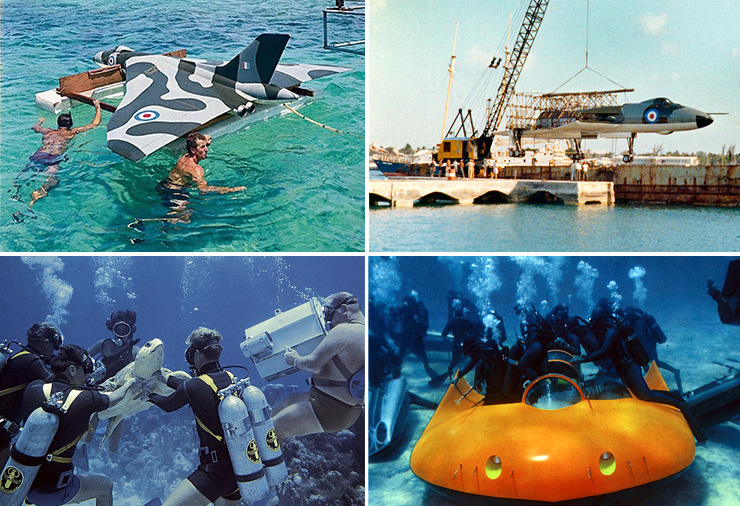
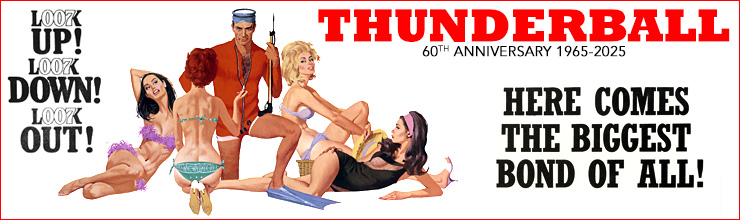
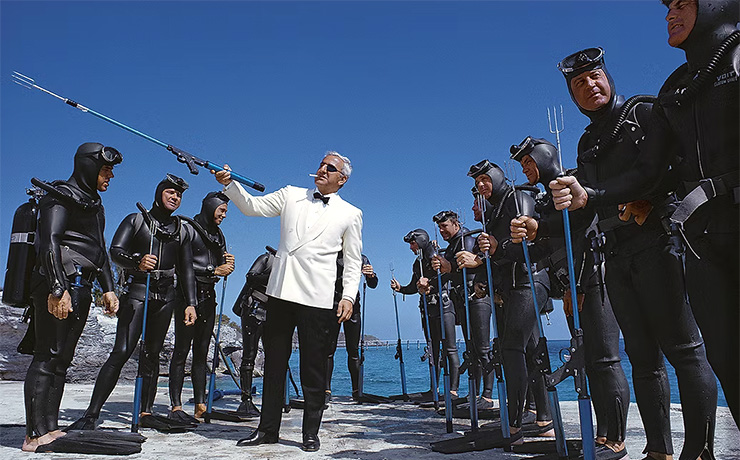
Thunderball was the last Bond film directed by Terence Young. On stage at London's National Film Theatre in 1990 he expressed his annoyance to the audience about the difficulty experienced obtaining a projectable quality 35mm print for the sell-out 25th Anniversary screening, organised by 007 MAGAZINE Editor & Publisher Graham Rye. Following the huge international success of Goldfinger in 1964, United Artists pulled out all the stops for their fourth James Bond film with an estimated budget of $5.6 million – almost double the budget of Goldfinger! Thunderball doesn’t skimp on its production values, with exotic locations and then state-of-the-art gadgetry – all highly visible on screen in a film which arguably still lives up to its tagline: “Here Comes The Biggest Bond Of All!” |
|||||
|
CONTINUED >> |
|
||||
|
|
|||||
 |
|||||
|
|
|||||