|
|
JAMES BOND
|
|
|
||
|
|
JAMES BOND
|
|
|
||
|
||||
 |
||||
|
||||
|
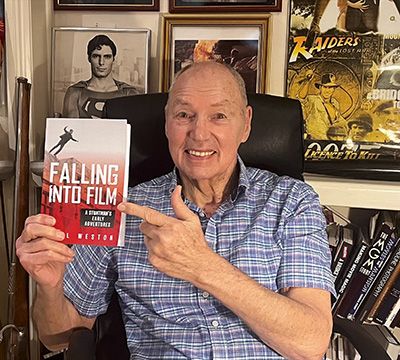
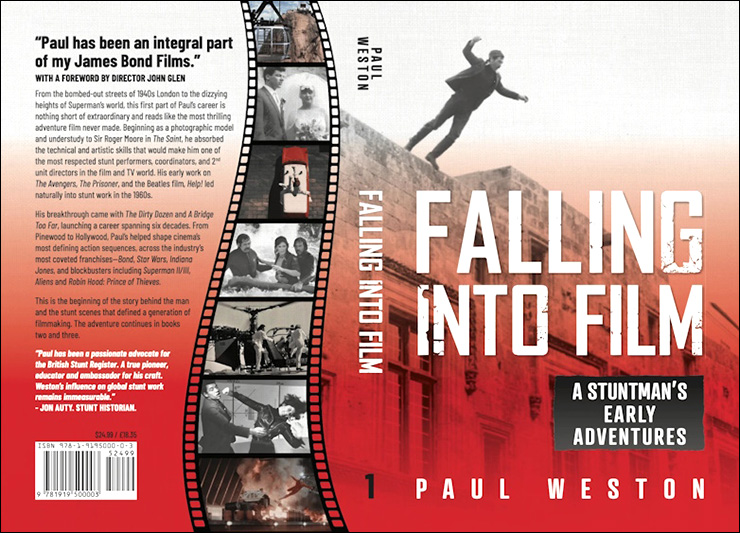
I approached Paul Weston’s memoir with a degree of trepidation. Self published books by Bond alumni are not always the most polished or compelling of tomes, and the prospect of three proposed volumes felt, at first glance, potentially egocentric or excessive. But my initial doubts evaporated almost immediately after I started reading this handsome and ultimately essential volume. Weston writes with clarity, control, and a sharp eye for the humorous or the absurd. By professional standards the book is impeccably edited – not a typo in sight – and the design is clean, unfussy, and unexpectedly elegant, even if the captions, or rather frequent lack of them, disappoints. For a self published work, such production values are unusual; for a Bond memoir of this kind, they are almost unheard of. And, as it turns out, the three volumes are necessary; Weston’s rollercoaster life and career demand the space. Ian Fleming’s elegant yet melancholic words with which I began this review capture the paradox that runs through Weston’s book: his stories may sound like tall tales, the breathless hyperbolic yarns of boys’ adventure fiction, but they are all true – and they belong to a world that has already slipped into history. Weston never frames his memoir as an elegy. He is too modest, too practical, too busy telling the next thrilling or crazy story. But the book he has written is an elegy nonetheless; an elegy for a craft, a culture, and a breed of men whose courage was physical, whose ingenuity was infinite, and whose artistry was measured in bruises, broken bones, and the split second timing of a fall. It is an elegy for an era before CGI, when cinema depended on real bodies doing real things in real space, not on the soulless drudgery of green screen and computer generated graphics. What makes this elegiac quality so striking is that Weston himself never indulges in nostalgia. He doesn’t lament the passing of the old ways; he simply describes them. But the reader feels the loss in every anecdote. The world he evokes – of stunt teams who knew each other’s strengths and weaknesses, of practical effects built from rope and steel, of directors who trusted stunt coordinators implicitly, of danger that could not and was not simulated – is gone. And the elegy deepens when we discover the unexpected corners of Weston’s life: the political theatre troupe he joined as a young man; his co-authorship of a fringe play called Vamp, his spell in London’s West End; and, tantalisingly, the uncredited idea he pitched to the BBC that was uncannily similar to what later became the hit ITV series Minder. These oddities reveal a man who was not just a stunt performer, but a hybrid from a broad artistic ecosystem in Britain that has also faded from view. Weston emerges from the memoir as far more than a stuntman. He is an enterprising writer and actor – he trained for three years at the respected drama school Mountview – as well as an ingenious and courageous stunt performer, stunt coordinator, and accomplished 2nd Unit Director. His memoir is by turns fascinating, humorous, and compelling, and Weston proves himself a sure handed storyteller with a keen eye for the dramatic beats of a life lived at the edge of danger. He tells his life not through introspection but through incidents – impacts, collisions, falls, explosions, narrow escapes. The early chapters have the energy of youth and apprenticeship: the young Weston watching stuntmen slide down the volcano set of You Only Live Twice, longing to be part of that world; the early jobs on The Saint and gradual immersion in the camaraderie of the British stunt fraternity. These are the stories of a man discovering his vocation, but they are also the stories of a profession discovering itself. The British stunt industry of the 1960s and 70s was a small, tight knit, fiercely loyal tribe – a world of handshakes, promises kept, and reputations earned through pain, with no insurance policies or compensation culture to provide a safety net. It is impossible to read these chapters without sensing that this tribe, too, has passed into legend. |
||||
 |
||||
|
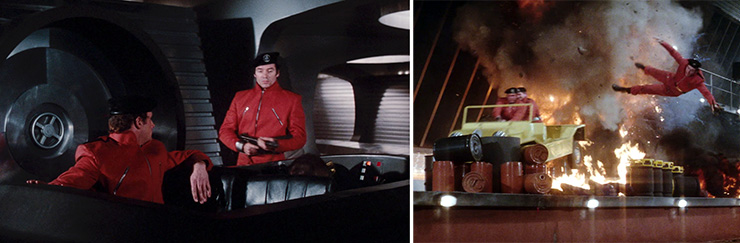
Weston’s Bondian breakthrough on The Spy Who Loved Me is told with his characteristic understatement. He describes the 007 Stage – Ken Adam’s cathedral of steel and water – with the awe of a craftsman entering a temple. The stunts themselves are described with a matter of fact precision that makes them more terrifying, not less: a 30 foot fall into seven feet of water; a monorail fight with Roger Moore in which he is kicked in the face – Weston never embellishes; he doesn’t need to, the facts are shocking and awe-inspiring enough on their own. And yet, beneath the surface, the reader feels the ache of something lost: the knowledge that such sequences, built with real bodies and real danger, are no longer part of mainstream filmmaking. The chapters on Superman and Superman II form the technical and emotional centrepiece of the memoir. They show Weston approaching the peak of his powers – not just performing stunts, but helping design and engineer them. The flying sequences are described with the loving detail of a man who understands both the physics and the poetry of the illusion. Fibreglass body moulds, front projection screens, vibrating wires, Bowden cables – Weston speaks the lost language of the pre digital effects age. He and his colleagues are like Victorian inventors and innovators, solving impossible problems with ropes, pulleys, wires, mirrors, and steely nerves. Their ingenuity is breathtaking. And again, the elegy is implicit: these crafts, these techniques, this kind of problem solving, have all but disappeared. Then comes the accident. It is one of the most harrowing passages in the book: Weston lifted too fast, swung like a pendulum, smashed into the projection screen, and dropped 12 feet onto the studio floor. The broken cheekbone. The torn ligaments. The concussion so severe that faces appear distorted. The fear that he might have brain damage or never look normal again. The fear that his daughters might be frightened of him. And then – in a moment that feels truly mythic – Superman himself, in the form of Christopher Reeve, arrives at Weston’s 12th-floor council flat in New Southgate, to visit him. It is a small act of kindness, but it lands with enormous emotional weight. Weston never milks it. He simply reports it. But the reader feels the tremor of something larger: the recognition between two men united by the medium of cinematic fantasy. It is one of the few moments where the memoir’s elegiac undertones rise to the surface. If the Superman chapters are the memoir’s technical heart, the Bear Island chapters are its narrative heart. They are astonishing – a bizarre blend of Jack London, Werner Herzog, and Ealing comedy. Weston, Vic Armstrong, Marc Boyle, and Dave Bickers are dropped into the frozen wilderness of British Columbia and Alaska, where they live in tents, dodge wolves, survive whiteouts, and perform stunts on a frozen lake six miles long. The wolf encounter is told with perfect comic timing: Weston wandering through the trees, admiring the snow, only to look down and find a huge, mangy wolf staring at him. The standoff. The slow retreat. The sprint back to the crew shouting, “It’s de wooliff!” is both terrifying and hilarious – the tone Weston excels at. But this passage is also a reminder of something deeper: that stunt work once required not just physical courage but a willingness to go to the ends of the earth, to live in conditions that would break most people. |
||||
 |
||||
|
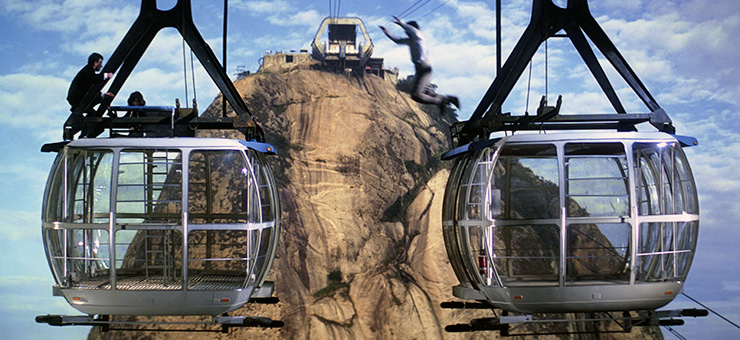
The Moonraker chapter contains one of the most extraordinary stunts in the book: Weston, doubling for Jaws, jumping 16 feet from one cable car to another using a trampoline strapped to the roof of the first car. It’s a stunt that shouldn’t work and It’s a stunt that Weston performs with a piece of orange peel wrapped in aluminium foil in his mouth, because the real Jaws teeth were somewhere in Paris. It is, in other words, the perfect metaphor for the era: danger, ingenuity, absurdity, and triumph all mixed together. And again, the elegy leaps out at the reader: this kind of madness, this kind of brilliance, has gone forever, replaced by soulless digital simulation. The Niagara Falls sequence in Superman 2 proves another masterclass in stunt coordination. Weston tests the rapids himself. He clears rocks at dawn while the falls are turned off. He protects stunt double Wendy Leech with the calm authority of a man who understands exactly how people die in water. The duck decoy he is given by riverman Wesley Hill – stripped of paint, battered by the Great Lakes, but still afloat – becomes an accidental symbol of the stuntman’s life. Weston keeps it on a cabinet still. It is his talisman, his reminder of survival. It is also the perfect emblem for the book itself: a small, battered object that has travelled through danger and come out the other side. Towards the end of the book, Weston pauses to list the names of stunt performers who have died. It is a simple list, but it echoes like a mournful tolling bell. A generation of physical artists, many of whom the public never knew, but whose bodies shaped the history of cinema, have gone forever. Weston does not dwell on this. He does not sentimentalise. But the elegy is there, in the silence between the names and the silence that comes when the reader closes the book. The world Weston describes – the world of practical stunts, of physical risk, of camaraderie forged in danger – is not just fading. It has gone. |
||||
|
|
And yet, through Weston’s narration, the old world does, magically, take shape again, briefly and brilliantly in our imaginations, like a figure suspended on wires against a projection screen, held aloft by skill, nerve, and the memory that for a moment – gone, but somehow still with us – someone, somewhere convinced us all that a man really could fly. |
||||
 |
JAMES BOND NEWS |
 |
||