|
|
Thunderball |
|
|
||
|
|
Thunderball |
|
|
||
 |
|
|||||
|
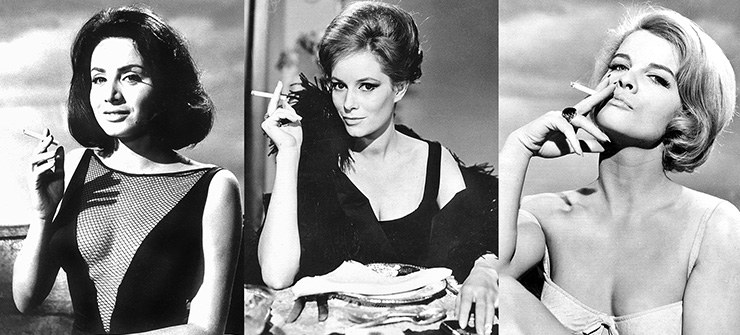
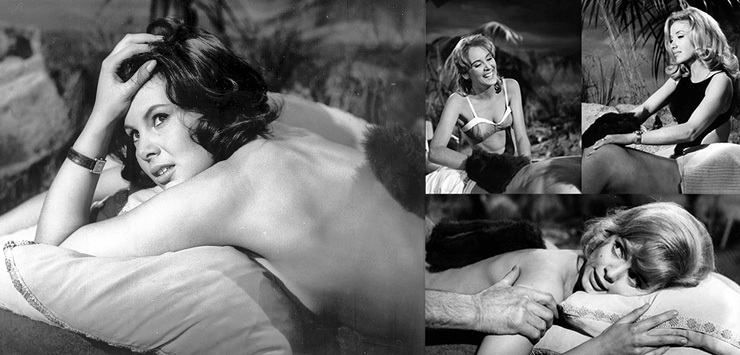
With a script and crew in place the production moved on to casting Thunderball. Harry Saltzman & ‘Cubby’ Broccoli were convinced that American actress Raquel Welch, although having made only one film, A Swingin' Summer (1965) – a beach party comedy-drama which had showcased her body rather than her acting abilities – made her ideal for the role of Domino. Although Welch initially signed for Thunderball, after a phone call from studio head Richard Zanuck in Hollywood, Broccoli released her from her contract in order she could sign with 20th Century Fox to appear in Fantastic Voyage (1966). Italian actress Luciana Paluzzi also tested for Domino after playing a small role in No Time To Die (1958) [US title Tank Force!] directed by Terence Young from a script by Richard Maibaum, and co-produced by Albert R. Broccoli with his then partner Irving Allen. After also considering Julie Christie and Faye Dunaway for Domino, former model and Miss France 1958, Claudine Auger eventually secured the key role, although in the final film her entire vocal performance was re-voiced by Nikki van der Zyl. Saltzman & Broccoli auditioned an extensive list of relatively unknown European actresses and models, including former Miss Italy Maria Grazia Buccella, French actress Yvonne Monlaur, best known for her roles in several Hammer Horror films in the 1960s, and British actress and dancer Gloria Paul. German actress Gisella Hahn tested as Fiona, with the role eventually going to Luciana Paluzzi, whose character Fiona Volpe did not appear in Fleming’s original novel. She was originally named Fiona Kelly in Maibaum’s script, but changed to Volpe to reflect Paluzzi’s Italian heritage. English model and actress Molly Peters was cast as Shrublands Nurse Patricia Fearing after playing a small role in The Amorous Adventures of Moll Flanders (1965), which was directed by Terence Young after he failed to come to terms with Harry Saltzman & Albert R. Broccoli during the pre-production of Goldfinger (1964). |
|||||
|
|||||
|
Italian actor Adolfo Celi was cast as the villainous Emilio Largo, although his entire vocal performance was replaced by Robert Rietty in post-production. The character of Felix Leiter was recast for the second time in Thunderball, with American actor Rik Van Nutter, who at that time was married to Swedish actress Anita Ekberg, who had appeared in Call Me Bwana (1963) for EON Productions and therefore was well-known to the producers. Of all the actors to play Felix Leiter, Van Nutter (pronounced Nooter) probably comes closest to Ian Fleming’s original interpretation of Bond’s CIA companion. Other roles were played by New Zealand-born character actor Guy Doleman as Count Lippe (called Lipson in the original script) fresh from playing Colonel Ross in The Ipcress File (1965) – a role he would reprise in the next two Harry Saltzman produced Harry Palmer films – Funeral In Berlin (1966) and Billion Dollar Brain (1967). After playing gypsy fighting girl Zora in From Russia With Love (1963), Jamaican born Martine Beswick returned to the series to play Bond’s Bahamian contact Paula. Terence Young’s friend, actor Anthony Dawson also returned to play Ernst Stavro Blofeld/Number One (again voiced by Eric Pohlmann), although neither actor was ever credited. |
|||||
 |
|||||
|
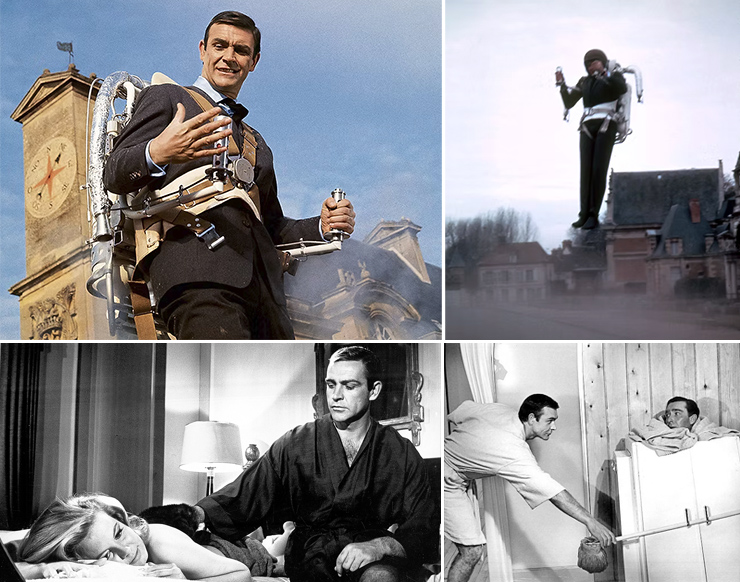
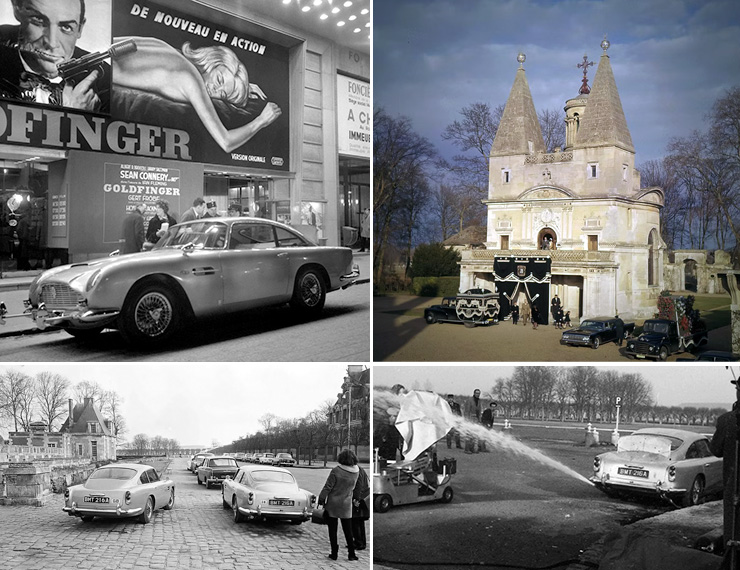
Principal photography commenced on February 16, 1965, with the pre-title sequence filmed at the Château d'Anet, near Dreux, west of Paris. During filming in France, Sean Connery arrived at the Paris premiere of Goldfinger (1964) on February 19, 1965 [pictured above top left], driving the Aston Martin DB5 Effects Car down the Champs-Elysees, accompanied by Aston Martin company sales representative Mike Ashley, who was then taking part in a World Tour with the DB5 to promote the third James Bond film. Although appearing to enjoy the experience in news footage from the event, Connery was mobbed by crowds upon his arrival, with one girl even managing to jump in through the open window of the car as he slowed down to stop outside the Marignan Cinema. The pre-credit sequence also introduces the Bell Textron Rocket Belt flown by 007 as he escapes from SPECTRE agents after killing Colonel Jacques Bouvar (Stunt Arranger Bob Simmons in drag) as he pretends to be the widow of the French agent whose funeral Bond has just spied on. The rocket belt was a real jet pack developed for the US Army by Bell Aerosystems, and flown in Thunderball by pilot Bill Suitor who doubles for Sean Connery in the brief sequence. The rocket belt had been sourced by retired US Air Force Officer Lt. Col. Charles Russhon, whose military connections and expertise also furnished locations on the six James Bond films he worked on as Technical Advisor. Russhon also appears (uncredited) in Air Force uniform in Thunderball in the background of the Whitehall briefing room set, where he can be seen playing what appears to be a game of Noughts and Crosses with Miss Moneypenny (Lois Maxwell). The pre-credit sequence also showcased Bond’s Aston Martin DB5 first seen in Goldfinger (1964). At the end of the pre-credit sequence the rear bullet proof shield is deployed, while the water cannon effect was achieved with a high pressure hose aimed at the camera by the local French fire brigade. The sequence was later cleverly integrated into the main title sequence by Maurice Binder, who was also returning to the series after a two-film break due to disagreements with the Saltzman & Broccoli over his remuneration. Binder would then stay with the series until his death in 1991. He became a key member of the franchise, also creating trailers and promotional materials used in marketing the films. |
|||||
|
|||||
|
Filming then began at Pinewood Studios on February 25, 1965, with the scenes at Shrublands Health Clinic. Exteriors of the Clinic were later filmed at Chalfont Park House in Buckinghamshire, where Count Lippe (Guy Doleman) waits for Patricia Fearing (Molly Peters) and Bond departs in his Aston Martin DB5. ‘Cubby’ Broccoli’s own Rolls-Royce Silver Cloud II makes a cameo appearance parked next to Lippe’s red Jaguar E-Type, which actually belonged to Thunderball Production Designer Ken Adam. Although screenwriter John Hopkins had initially been engaged on January 26, 1965, for three weeks of rewrites, he ended up remaining on the project for two months. As Hopkins finished his work on the Thunderball script on March 22, 1965, 102 cast and crew members plus their equipment flew to Nassau in The Bahamas for location filming. Shooting began on March 24, 1965, with the scenes between Bond and Domino at the poolside after their initial underwater meeting, and was followed by their dinner at Café Martinique on Paradise Island. Through Kevin McClory’s friendship with Huntington Hartford the production were given permission to shoot footage on his private island and he is thanked at the end of the film. George Huntington Hartford II (1911–2008) was an American businessman, philanthropist, stage and film producer, and art collector. After his father's death in 1922, Hartford became one of the heirs to the A&P supermarket fortune, and the estate left by his grandfather and namesake. In 1950 his sister Josephine (1903-1992) had married Ian Fleming’s close friend John Felix “Ivar” Charles Bryce (1906-1985) and helped finance Kevin McClory’s 1959 film The Boy And The Bridge. Opened in 1962, Paradise Island was an exclusive gambling resort and also home to The Ocean Club which later featured prominently in Casino Royale (2006). Huntington Hartford’s then wife Diane [born Diane Brown in 1941], has a cameo in Thunderball as the woman James Bond (Sean Connery) briefly dances with at the Kiss Kiss Club in Nassau, and 41 years later in Casino Royale as a card player at The Ocean Club when Bond (Daniel Craig) wins an Aston Martin DB5 from Alex Dimitrios (Simon Abkarian). Kevin McClory made an uncredited cameo appearance in Thunderball when James Bond enters Café Martinique, with several other Nassau residents appearing as background extras at the location. Whilst on the island the producers recreated the famous Junkanoo festival, a sort of Mardi Gras that took place every year on Boxing Day, believing it would make a lively backdrop for a chase sequence. To ensure the locals turned out in force, the production offered £1,000 prize money for the best costume and carnival float. Director Terence Young instructed his camera crew to weave in and out of the crowd, in an almost cinema verité style, although in one scene several revellers can be clearly seen with ‘007’ emblazoned on their costumes! The resulting footage filmed over several nights in Mid-April 1965 was cleverly manipulated in the editing so that some shots are reversed or speeded up, but on close inspection is one of the sequences which show how many shots Peter Hunt used in a way not originally intended, in order to make the action flow. The same is true of the climactic underwater battle, which has many similar mismatched shots resulting in sloppy continuity errors. |
|||||
|
|||||
|
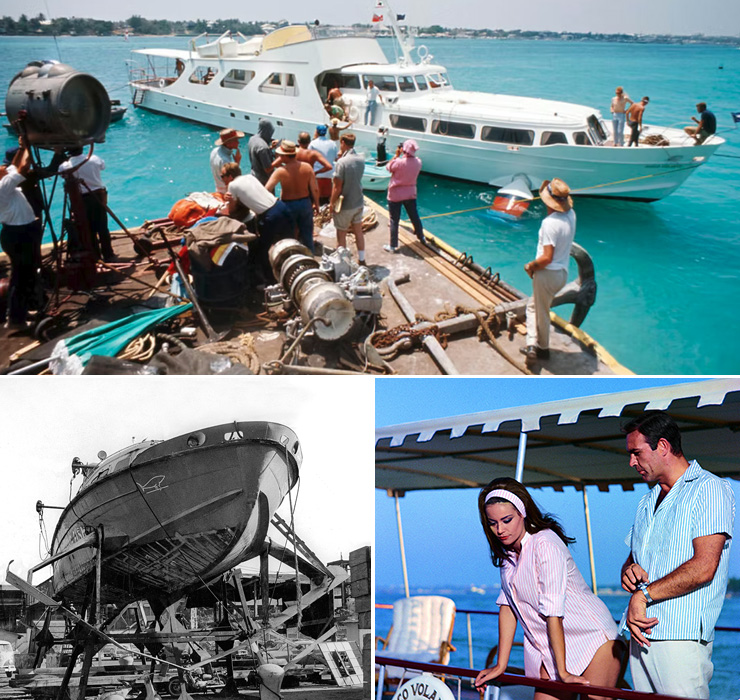
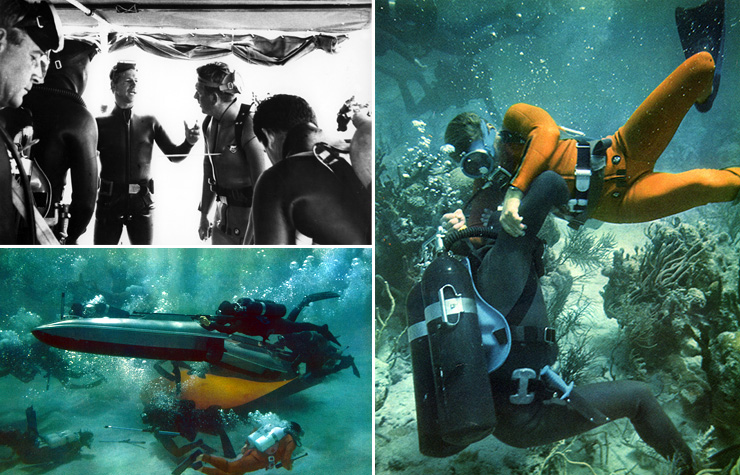
Filming on board the Disco Volante began on April 12, 1965, with a scene where Bond searches for the stolen bombs using his Geiger counter watch. Filmed over three days, the scene was eventually deleted from the final cut of Thunderball (1965). Largo’s hydrofoil had been purchased in Puerto Rico, and its conversion into an armoured catamaran supervised by Art Director Peter Murton in Miami. For the scenes at Largo’s villa Palmyra, the crew used a house owned by local millionaire Nicholas Sullivan, situated at Rock Point on New Providence Island, which had the two pools required by the script. Filming at Rock Point began on April 26, 1965, and included the scene where Bond (Sean Connery) swims through a tunnel and ends up in a pool with sharks. Production Designer Ken Adam constructed the tunnel out of Plexiglas, but did not have enough materials to completely separate the actor from the sharks, and one ended up swimming through the gap. Connery’s reaction to coming face-to-face with a Tiger shark was not acting! The scenes at Rock Point were filmed over four days and nights, and on May 10, 1965, filming began on the climactic battle between the SPECTRE frogmen and US Navy Aqua-Paratroopers at Lyford Cay. Much of the choreography for the fight was rehearsed on dry land in a car park before the 45 divers employed by Ivan Tors’ unit attempted to replicate their action underwater. On May 31, 1965, Special Effects Supervisor John Stears blew up the Disco Volante using dynamite and experimental rocket fuel acquired by technical advisor Charles Russhon (1911-1982). Stears was not informed how powerful the rocket fuel was, and there was no way to test it beforehand. The resulting explosion was filmed on Rose Island three miles east of Paradise Island, and sent 40 tons of boat into the air above the crew. Miraculously nobody was injured or hit as the debris returned to earth. The blast was so powerful that it blew out windows 30 miles away in Nassau. |
|||||
|
|||||
|
CONTINUED >> |
|
||||
|
|
|||||
 |
|||||
|
|
|||||