|
|
Thunderball |
|
|
||
|
|
Thunderball |
|
|
||
 |
|
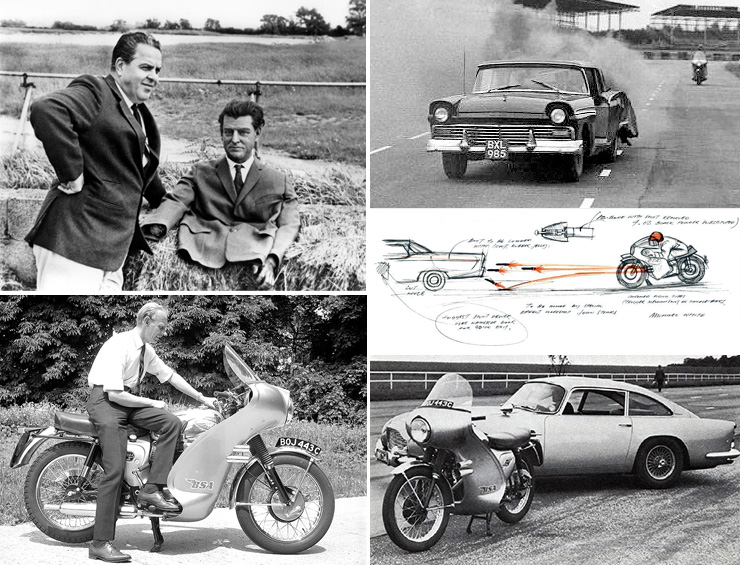
Returning to England the crew filmed Count Lippe’s demise at Silverstone Racetrack in Northamptonshire on June 21, 1965. As the vehicles were required to travel at high speed and Fiona’s BSA motorcycle needed to fire a rocket at Lippe’s Ford Fairlane Skyliner, Silverstone was chosen rather than a public highway in order to control the action, although long shots of the location do give this away. As the Ford was a left-hand drive vehicle, Stuntman Bob Simmons drove the car crouched down at the opposite side via a modified steering mechanism, with a dummy of Lippe placed in the driver’s seat. Stuntman George Leech drove the Aston Martin DB5, with Johnny Walker riding the BSA Lightning motorcycle which was modified to fire a rocket. Explosives in the rear of the Ford were detonated and timed to make it look as if Fiona (Luciana Paluzzi) had assassinated Lippe (Guy Doleman) before ditching the motorcycle in a nearby lake. The Ford Motor Company supplied two cars for the sequence, which was successfully completed on the first attempt, although weather conditions were not ideal. The crew returned to Silverstone the following day for pickup shots and as the weather was perfect it was decided to restage the stunt. Once again Bob Simmons and John Stears’ effects team completed the dangerous stunt for a second time and these takes were used in the finished film. The Ford Motor Company had their own film crew present on June 21st and filmed the behind-the-scenes action for their promotional short A Child’s Guide To Blowing Up A Motor Car. The 16-minute film was written by British comedy writer and presenter Denis Norden (1922-2018), who also appears as the benevolent godfather who takes his godson Christopher to visit the set of Thunderball during filming at Silverstone. Included on the Thunderball DVD and Blu-ray, the tongue-in-cheek promotional mock-documentary is a fascinating record of how the James Bond films were made by an expert team of stunt performers and special effects technicians in the days before computer generated imagery. |
|||||
|
|||||
 |
|||||
|
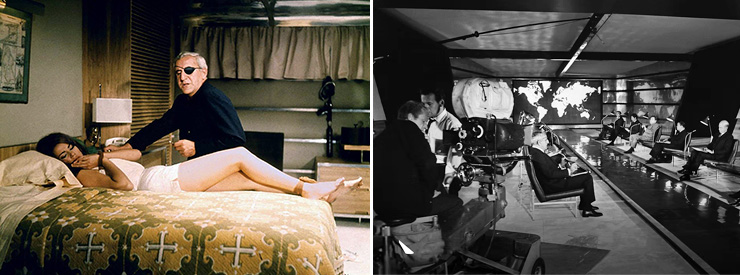
At the end of production, scenes with Adolfo Celi and the Ken Adam designed SPECTRE boardroom were filmed, and also Largo’s torture of Domino aboard the Disco Volante on a soundstage at Pinewood Studios. Shots of the cockpit of the sunken Vulcan bomber were filmed in Pinewood’s tank, which was also used by Maurice Binder for his Main Title sequence. Filmed over three days, with models Christina Hayward and Jean McGrath covered in black make-up so they would be silhouetted against the white background of the tank, the sequence was later coloured by Binder using different gels and an optical printer to combine the various elements into a mini pop-art masterpiece. |
|||||
|
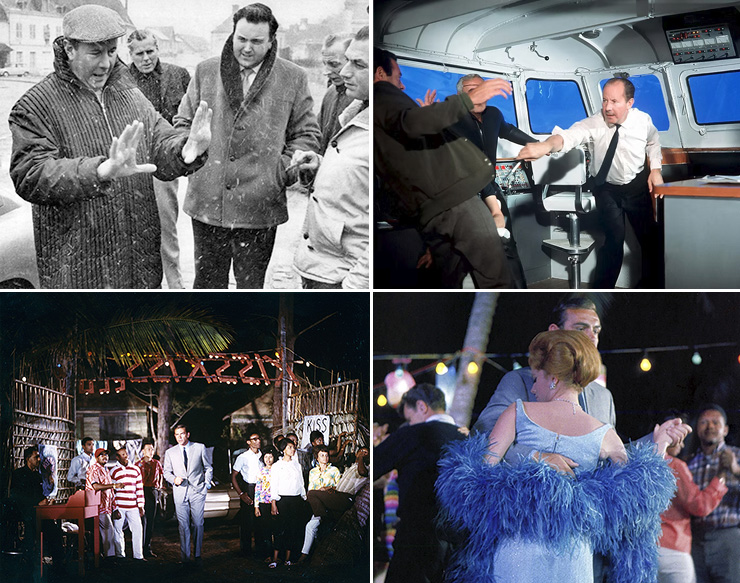
Filming on Thunderball ended on July 8, 1965, and Supervising Editor Peter Hunt had very little time left to meet the deadline to have the film ready for the proposed October 21st Premiere. Director Terence Young had already left to begin filming The Poppy Is Also a Flower in the south of France. From a story by Ian Fleming, The Poppy Is Also a Flower was an American-French-Austrian made-for-television spy and anti-drug film, produced under the auspices of the United Nations as part of a series of television specials designed to promote the organization's work. Peter Hunt and Editor Ernest Hosler more or less shaped Thunderball in the editing stage, although mismatched shots and continuity errors are more apparent than in earlier films. They used bold cutting techniques to keep the story moving and with much of the action taking place underwater, speeded up certain sequences to enhance the pacing. This is particularly apparent in the cutting of the death of Fiona at the Kiss Kiss Club in Nassau. The frantic editing of the sequence is one of the stand-out moments in the film, as are the clever use of optical wipes and dissolves to quickly move the action from one scene to another. |
|||||
|
|||||
|
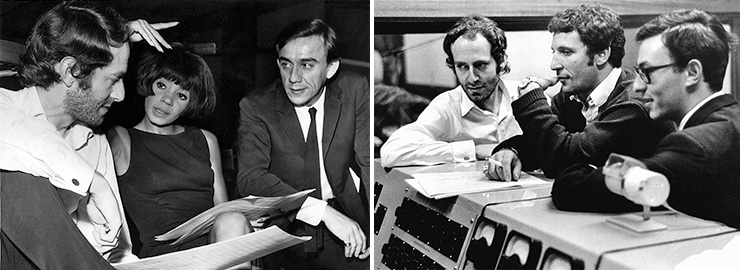
Composer John Barry also had very little time in which to complete his score, which was his longest to date, with over 90 minutes of music written and recorded, although several cues did not make it into the finished film. United Artists had also insisted that a soundtrack album was issued ahead of the US release and consequently the resulting LP did not include any music from the second half of the film as Barry did not finish recording until November 17, 1965. Consequently these post–production delays meant that the film missed its original Premiere date and the release was rescheduled for the end of the year. It was originally planned to use ‘Mr Kiss Kiss Bang Bang’ co-written with Leslie Bricusse as the title song, and this theme was also woven throughout John Barry’s score. The song was originally recorded by American singer Dionne Warwick on September 4, 1965, and then by Shirley Bassey on October 12, 1965. The Producers had concerns that the song did not mention the title of the film, so the Dionne Warwick version featured a longer instrumental opening, in order that the lyrics would not start before the word “Thunderball” appeared in Maurice Binder's title design. Lyricist Don Black then collaborated with John Barry on a new song written over a weekend in mid-September. Tom Jones was brought in to record ‘Thunderball’ for the main titles and the Shirley Bassey vocal would be heard over the end credits. ‘Cubby’ Broccoli was ultimately unimpressed by Bassey’s performance and made the decision to remove the song from the film completely. The Welsh singer, and her then husband and manager Kenneth Hume, promptly sought a High Court injunction against the release of Thunderball if her recording of ‘Mr Kiss Kiss Bang Bang’ was not featured in the film and she received a prominent on-screen credit. The judge Mr. Justice Lyall ruled that the production of Thunderball was so far advanced and with the British Premiere was now fixed for December 29, 1965, it was too late to grant an injunction to stop the release. In his affidavit Albert R. Broccoli stated that in order to meet the earliest release date of December 10th in South Africa, the film had to be completed and ready to be delivered to Technicolor so that prints could be processed. A massive publicity campaign had already been agreed to coincide with the release dates and the cost in the United States alone had exceeded £200,000. PAN Books had also printed 500,000 paperback copies of THUNDERBALL to tie in with the film which had already been withheld when the release date was changed in post-production. Any further delays would also seriously damage the commercial relationship with the Rank Organisation, who would be distributing Thunderball in the United Kingdom. Broccoli also asserted that including Bassey’s recording of ‘Mr Kiss Kiss Bang Bang’ on the soundtrack would not enhance her considerable reputation as it was “artistically unmeritorious”. The Shirley Bassey and Dionne Warwick recordings would not get a commercial release until 1992 when they were included on Disc 2 of ‘The Best of James Bond 30th Anniversary Collection’ CD. The Court of Appeal therefore upheld the original decision ruled on November 17, 1965, and suggested that Shirley Bassey seek damages rather than halt the release. The case was subsequently settled out of court, but Kenneth Hume curtailed any further connection with EON Productions, and it was not until after his death in 1967 that the singer returned to the franchise at the request of composer John Barry for Diamonds Are Forever (1971) and Moonraker (1979). |
|||||
|
|||||
|
|||||
|
CONTINUED >> |
|
||||
|
|
|||||
 |
|||||
|
|
|||||