|
|
Thunderball |
|
|
||
|
|
Thunderball |
|
|
||
 |
|
|||||
|
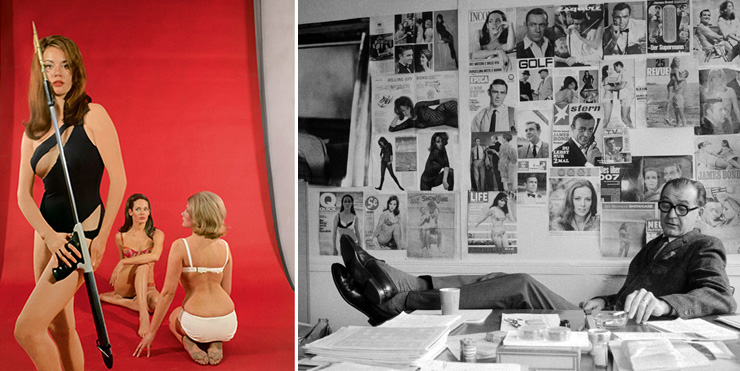
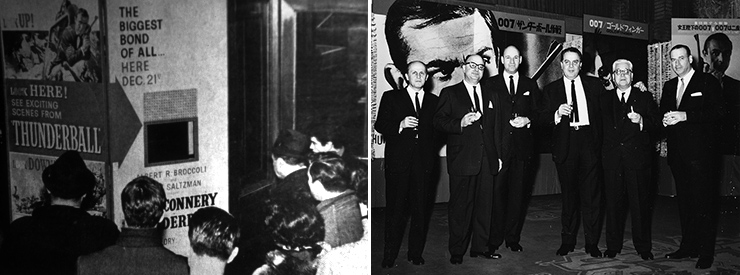
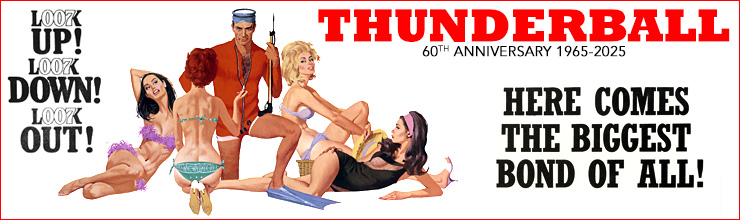
To create the poster campaign for Thunderball, United Artists publicist Tom Carlile engaged the services of two American illustrators – Frank C. McCarthy and Robert McGinnis – who travelled to England to observe the shooting and draw inspiration from the special photo sessions with the four female leads. The UK posters featured the Robert McGinnis artwork of James Bond flanked by the four girls, that also appeared in the US and international campaign joined by two further pieces of artwork by Frank McCarthy. The three panel posters were reconfigured and used throughout the world to promote Thunderball. McGinnis and McCarthy returned for You Only Live Twice (1967), which featured a similar triptych campaign, and also collaborated on artwork for On Her Majesty’s Secret Service (1969). McGinnis then provided the poster artwork for the next three films in the EON Productions series. Main Title designer Maurice Binder also assembled a theatrical trailer which played in cinemas long before the release and was so popular that a special viewing booth was erected outside the Paramount Theatre in New York a month before the US Premiere on December 21, 1965, to allow Broadway passers-by to see the trailer on a 24-hour loop. |
|||||
|
|||||
|
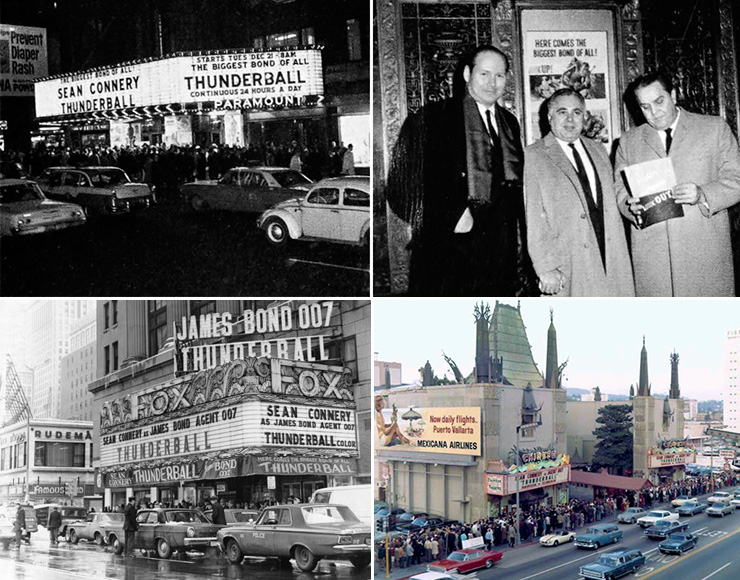
Thunderball had its world premiere before an invited audience at the Hibiya Theatre in Tokyo, Japan, on December 9, 1965, with producers Kevin McClory and Albert R. Broccoli in attendance. At a press reception prior to the screening, Broccoli announced that director Lewis Gilbert would return to Japan in February 1966 to begin pre-production on You Only Live Twice, the next James Bond adventure. Originally, On Her Majesty’s Secret Service had been slated as the follow-up, but the end credits of Thunderball were hastily altered with a clumsy optical wipe to remove any reference to that title. The Thunderball U.S. premiere took place at the Paramount Theatre in New York City on December 21, 1965, attended by Harry Saltzman, Broccoli, and United Artists executive David Picker, along with his father Eugene, then vice-president of the studio. The event was marked by drama when William P. “Bill” Suitor, pilot of the Bell Textron jet pack featured in the film, was arrested for performing a publicity stunt without the proper permit – flying off the cinema’s marquee! The Paramount Theatre itself, a 3,664-seat venue at 1501 Broadway, had originally opened in 1926 and was often used for concerts before closing in September 1964. It was reopened specially for Thunderball, which ran until February 21, 1966. Between December 22, 1965, and January 3, 1966, the theatre remained open 24-hours-a-day to screen the film – a profitable strategy previously employed for the New York launch of Goldfinger. On the same day as the New York premiere, Thunderball also opened at “Premiere Showcase” theatres across the city and began an exclusive engagement at Grauman’s Chinese Theatre in Hollywood. The film played there for an extraordinary 21 weeks, with additional midnight and 2:30 a.m. screenings scheduled to accommodate the overwhelming demand. |
|||||
|
|||||
|
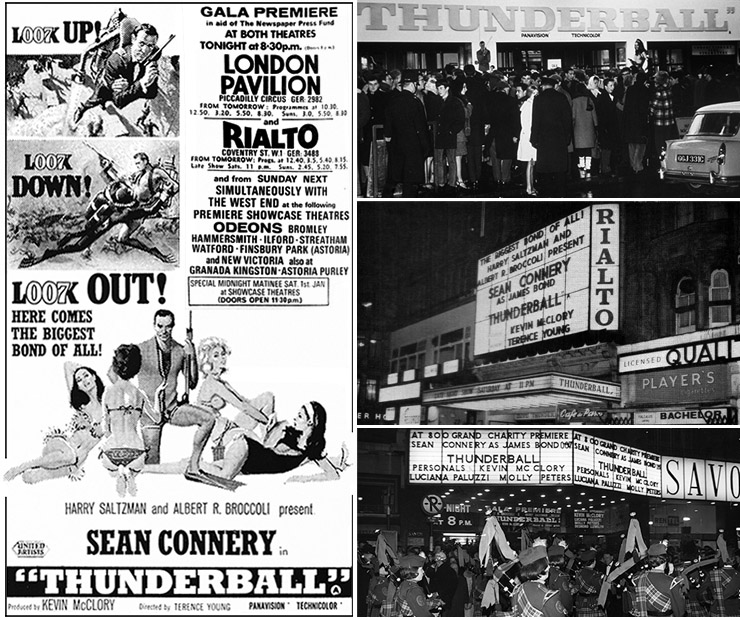
Thunderball held its Gala Premiere in London at two West End venues on Thursday, December 29, 1965. Following its double premiere at the London Pavilion and Rialto cinemas, the film opened at nine ‘Premiere Showcase Theatres’ across London, with sell out midnight matinees on Saturday, January 1, 1966. The ODEONs Bromley and Streatham even played to standing customers. The nine Showcase Theatres alone took £9,100 on Sunday, January 2, 1966. Thunderball grossed a mammoth £8,120 at the London Pavilion in the first four days, and £3,724 at the Rialto. This marked the last use of the Showcase distribution model in London, introduced for Goldfinger. Within a week, Thunderball had broken house records set by Goldfinger at the 11 London cinemas where it was playing. It remained at the London Pavilion for 19 weeks and at the Rialto for 12 weeks, before opening in key UK cities from February 6, 1966, and then wider general release. |
|||||
 |
|||||
|
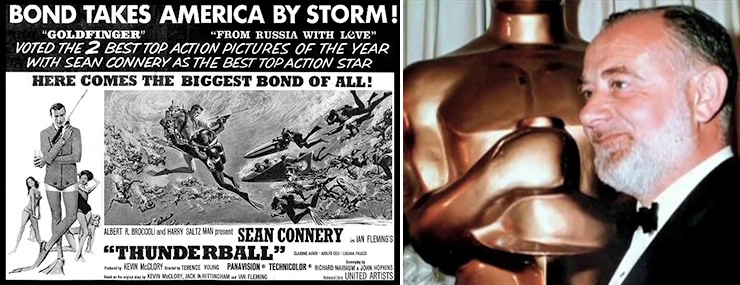
Thunderball out-grossed the three previous Bond films by a significant margin, taking $142 million worldwide and marking the zenith of ‘Bondmania.’ Myriad merchandising opportunities further consolidated the film’s success. At the 1966 Academy Awards, hosted by Bob Hope and the first Oscars to be broadcast live in colour, Thunderball won Best Special Effects, though recipient John Stears only learned of his win when an American friend called to say Ivan Tors had collected the statuette on his behalf. This was the second Oscar for the Bond series, after Norman Wanstall’s Best Sound Effects win for Goldfinger, and remarkably, the last Oscar win until Skyfall in 2012. |
|||||
|
|||||
|
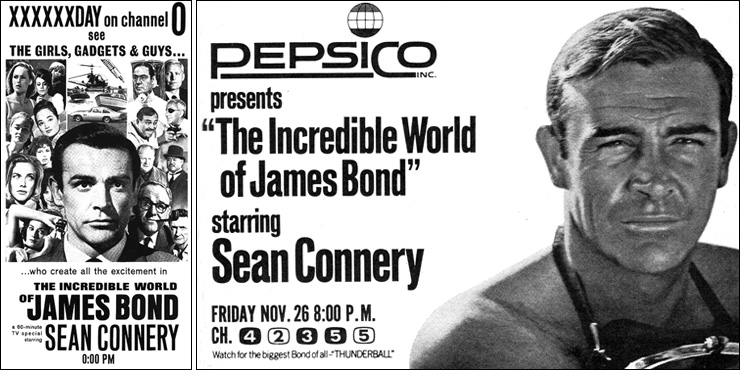
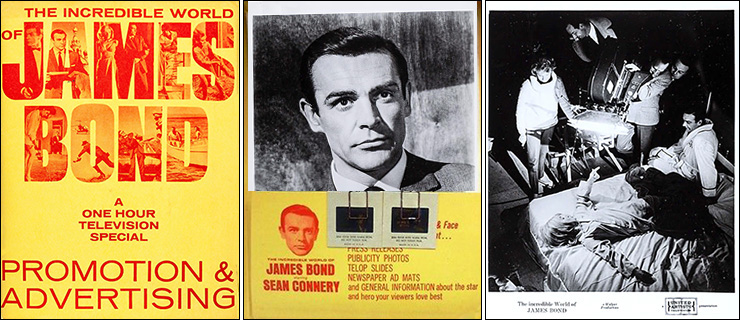
Thunderball was the must see film of Christmas 1965. With global awareness at its peak, on November 26, NBC broadcast The Incredible World of James Bond, a one-hour documentary tracing Bond’s literary roots and showcasing behind the scenes footage from Thunderball. LIFE Magazine, PLAYBOY, and other major publications featured the film, cementing its cultural dominance. The documentary aired in the UK on February 5, 1966, to coincide with the general release. Although Sean Connery was initially announced as narrator, he declined, not wishing to reinforce his association with Bond; American actor Alexander Scourby replaced him. Scourby (1913-1985) would later provide narration (as James Bond) for the controversial two-part screening of On Her Majesty’s Secret Service (1969) on ABC-TV in 1978. |
|||||
|
CONTINUED >> |
|
||||
|
|
|||||
 |
|||||
|
|
|||||