|
|
Thunderball |
|
|
||
|
|
Thunderball |
|
|
||
 |
|
KEVIN HARPER looks back at the making of Thunderball, released 60 years ago as the fourth entry in the long-running EON Productions James Bond film series. Originally planned as the first 007 film in 1961, Thunderball was shelved when litigation engulfed the property. Four years later, it emerged as a co-production with Kevin McClory, who had won the film rights after a bitter court battle with author Ian Fleming. The release of Thunderball in 1965 cemented Bond’s global dominance and remains a landmark in the franchise’s history. |
|||||
|
|||||
|
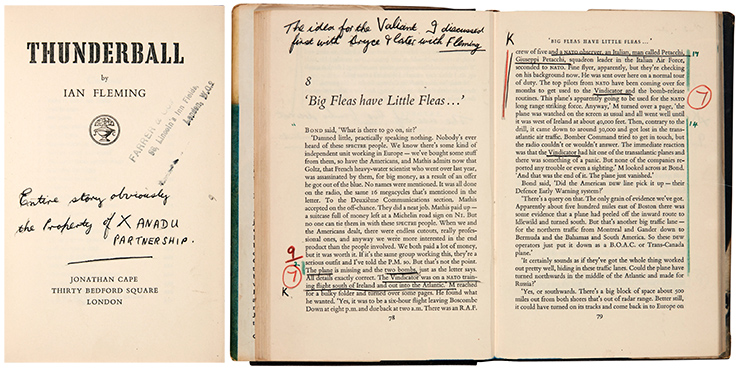
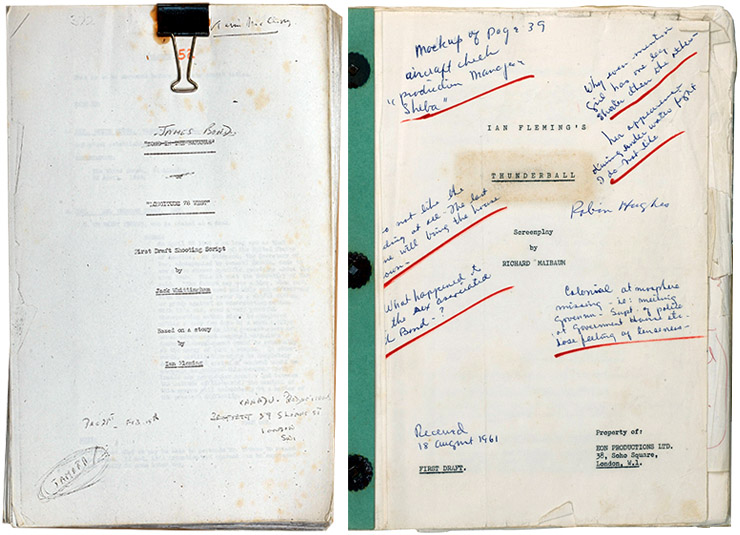
Following their acquisition of the rights to film the James Bond novels in 1961, producers Harry Saltzman & Albert R. Broccoli chose Thunderball as their first title as the novel was the most recently published and then a best-seller. They appointed American writer Richard Maibaum (who had collaborated with Broccoli on several of his Warwick Film productions) to write a screenplay based on Ian Fleming’s ninth James Bond novel. Maibaum was hired on July 21, 1961, and delivered his first draft screenplay on August 18, 1961. At this stage EON Productions was unaware a screenplay already existed, written by Jack Whittingham based on Ian Fleming’s first draft film treatment James Bond of the Secret Service. In 1959, together with boyhood friend and fellow Etonian, Ivar Bryce, Fleming joined forces with Irish filmmaker Kevin McClory with the intention of bringing James Bond to the big screen, and he and McClory came up with a story idea where the Mafia blackmail the Western powers by threatening to detonate a stolen atomic warhead if their demand for £100 million is not paid. McClory brought in English screenwriter Jack Whittingham to further adapt the story, and he duly went on to write his first draft script, now titled Longitude 78 West. As Whittingham worked on his script, Ian Fleming had begun to develop the various film treatments into a novel that was ultimately published as THUNDERBALL on March 27, 1961. With McClory unable to secure financial backing for his James Bond film, the project fell apart and the three men parted company |
|||||
|
|||||
|
Upon reading an advance copy of THUNDERBALL, Kevin McClory immediately recognised that it was based upon the storylines he had collaborated on and instigated legal proceedings for breach of copyright. McClory and Whittingham petitioned the High Court in London for an injunction to stop publication and the case was heard on March 24, 1961. The judge, Mr. Justice Wilberforce, allowed the book to be released by Jonathan Cape as planned, as the publication date was very close and 32,000 copies were already with booksellers. Additionally, Ian Fleming had not been given sufficient time to mount a defence. With no injunction granted, McClory’s case then turned to damages for breach of copyright and the false attribution of authorship of THUNDERBALL, with the case eventually heard in the High Court in November 1963. The lawsuit was ultimately settled out of court, with McClory awarded the literary and film rights for the screenplay, and Fleming given the rights to the novel, although it had to be recognised in later printings as being “based on a screen treatment by Kevin McClory, Jack Whittingham and the Author”. |
|||||
|
|||||
|
EON Productions were aware of the litigation surrounding the THUNDERBALL project during their initial pre-production in 1961, even though United Artists lawyers had warned them off. Producers Saltzman & Broccoli approached Kevin McClory in August 1961 in the hope of forming an agreement whereby they could make Thunderball as the first James Bond film. In view of the pending trial, the producers eventually backed off, as the rights were likely to be in dispute for some time, and went ahead instead with plans to film DR. NO. Ahead of the trial, EON Productions first two James Bond Films, Dr. No (1962) and From Russia With Love (1963) were released to great international success, and their third film Goldfinger hit UK cinema screens in September 1964 to even greater acclaim and record-breaking box-office returns. Saltzman & Broccoli then planned to film ON HER MAJESTY’S SECRET SERVICE as Sean Connery’s fourth 007 outing, and pre-production had begun from a script written by Richard Maibaum. The end credits of Goldfinger (1964) originally announced On Her Majesty’s Secret Service as the next film in the EON Productions series. After gaining the screen rights to THUNDERBALL in late 1963, Kevin McClory immediately began planning a film of his own and set about looking for an actor to play James Bond. Welsh-born actor Richard Burton was one of the names approached by McClory, and according to Press reports in February 1964 was close to signing a deal. McClory eventually conceded that Sean Connery was the only name the public wanted to see as 007 and resumed negotiations with EON Productions. Meanwhile, Saltzman & Broccoli were having their own difficulties, as another rival James Bond production was also being planned after they failed to agree a deal with American producer Charles K. Feldman, who held the rights to Ian Fleming’s first novel, CASINO ROYALE (1953). Rather than have another rival production hamper their success, the three men eventually came to an agreement on September 23, 1964 – just six weeks after the death of author Ian Fleming; Kevin McClory would receive sole producer credit, $250,000 cash, plus 20% of the profits on the proviso that he could not produce another film from the rights he still retained for another 10 years. Thunderball was then announced as the next James Bond film and all 35mm prints of Goldfinger being prepared for the US opening in December 1964 (and all new UK prints for the general release across the UK) were revised so the end credits no longer proclaimed On Her Majesty’s Secret Service as the next Fleming title to be filmed. |
|||||
|
|||||
|
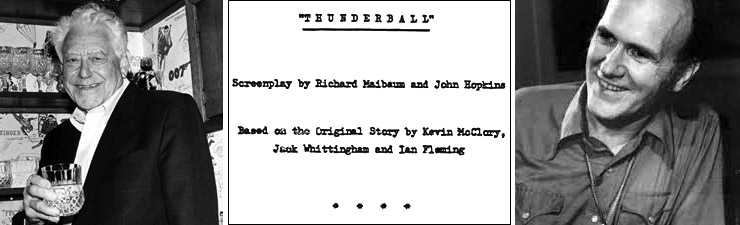
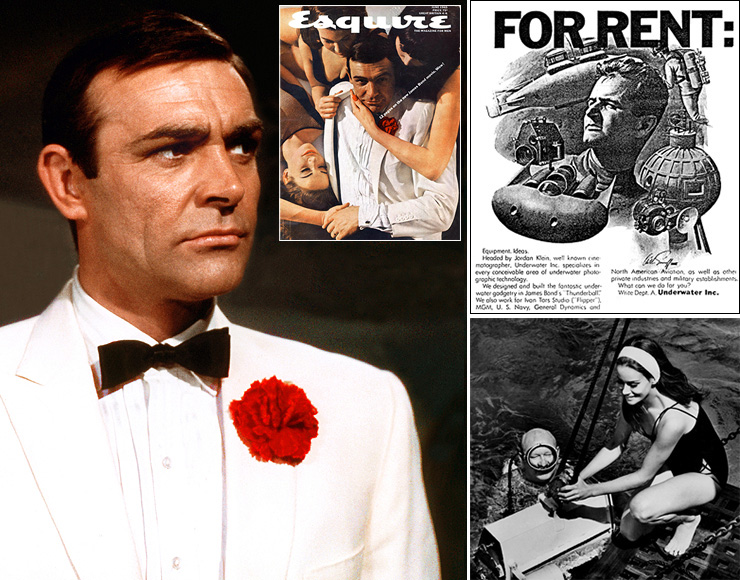
Richard Maibaum’s 1961 THUNDERBALL script was dusted off and revised further by English screen, TV and stage writer John Hopkins, who was originally employed by Harry Saltzman to write the screenplay for Funeral In Berlin (1966), the second Harry Palmer film starring Michael Caine, based on the novel by Len Deighton. Hopkins was primarily known as a TV writer and had written scripts for 53 episodes (1962-64) of the popular BBC-TV police procedural drama series Z-Cars (1962-78). Hopkins would later write the stage play This Story of Yours (1968), that so impressed actor Sean Connery he purchased the property, which was later developed into the screenplay for The Offence (1973) – the one film made as part of his three-picture deal with United Artists in returning to the role of James Bond in 1971, and which gave Connery arguably the finest screen performance of his long career. Goldfinger director Guy Hamilton declined to return to direct Thunderball, feeling creatively drained and choosing to work on Funeral In Berlin (1966). Saltzman & Broccoli then approached Terence Young, who agreed to return to the series for a third time after finally agreeing terms with the producers. Sean Connery’s own salary was increased significantly to $750,000 plus 5% of the producers’ profits. Other returning crew from earlier Bond films included Production Designer Ken Adam and his Art Director Peter Murton, Cinematographer Ted Moore, Stunt Arranger Bob Simmons, Editor Peter Hunt, and Special Effects Supervisor John Stears. As much of the film takes place underwater the production engaged the services of an American team, including Ivan Tors Underwater Studios Ltd., Underwater Director Ricou Browning, Underwater Cameraman Lamar Boren, and Underwater Engineer Jordan Klein. |
|||||
|
CONTINUED >> |
|
||||
|
|
|||||
 |
|||||
|
|
|||||